 Azabudai Hills Tokyo
teamLab Borderless Photos: Rules, Rooms and Settings
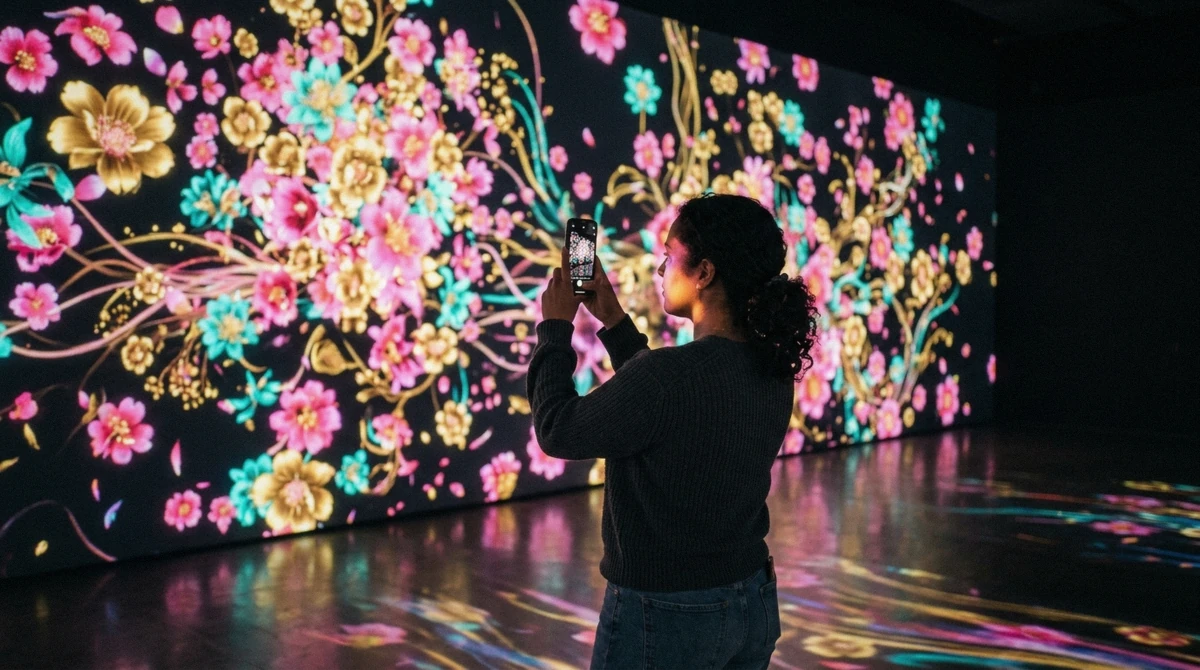
Most teamLab Borderless photos are taken on a phone in the dark, which is why so many of them come back blurred. The museum allows photography and video throughout, and almost every visitor leaves with a full camera roll, but the rooms are genuinely dark in places, the floors of several rooms are mirrored, and a normal camera habit like a tripod or a portrait-mode phone shot works against you here rather than for you. This is the practical version: the rules that actually apply, which named rooms photograph best and how hard each one is to shoot, real settings for shooting in near-darkness, what to wear and carry, and when to arrive so the room is not full of other people's arms in your frame. For ticket prices, hours and how the museum sits inside the wider complex, see our Azabudai Hills visitor guide.
Quick answer
Bubble Universe and Infinite Crystal World are the two most photographed rooms at teamLab Borderless, and the first weekday slot at 8:30 is the emptiest window for a clean frame. Photography and video are allowed and postable, but flash is banned, nothing over 30 centimetres is allowed as a support, so no tripods or selfie sticks, and mirrored floors mean skirts and dresses need the wrap-around cover staff hand out at the door. A guided visit with the timed slot already booked, such as the three-hour Borderless walk, removes the one variable you cannot control yourself: how early you actually get inside.
Key takeaways
- No flash, nothing over 30 cm as a support, so no tripods, monopods or selfie sticks
- Bubble Universe and Infinite Crystal World are the two standout rooms for photographs
- Mirrored floors in several rooms; wrap-around skirts are lent free at the entrance
- The 8:30 opening slot on a weekday is the emptiest window for a clean shot
- Full ticket and hours detail lives on the Azabudai Hills Borderless page
- There is no time limit once inside, so a slow first pass and a faster second pass both work
The Rules First
Photography and video are allowed throughout teamLab Borderless and you may post what you shoot, which is unusual for a museum this dark and this delicate to light. The restrictions that do exist are specific rather than sweeping, and worth knowing before you arrive rather than being told at the door.
- No flash, anywhere in the building. It washes out the projected light the rooms are built around and the museum enforces this
- No support over 30 centimetres. That rules out tripods, monopods and selfie sticks outright, whether for a phone or a camera
- Mirrored floors in several rooms mean skirts and dresses are a genuine hazard underfoot; staff lend wrap-around skirts at no charge if you need one
- No re-entry once you leave, and no printed map, so there is no way to plan a room-by-room shot list in advance the way you could at a fixed-layout venue
- Filming for commercial purposes needs prior consent from the museum, and unrelated media crews may be shooting inside without individual notice to visitors
One more thing worth knowing before you plan a shot: the artworks themselves run on cycles that last several minutes, so a room photographed at the start of your visit can look meaningfully different an hour later. If a room disappoints on the first pass, a second pass later in the visit is not a wasted walk. There is also no limit on how long you can stay once inside, so nobody is going to move you along mid-shot the way a crowded gallery might, though no re-entry means all of that time has to happen in one continuous visit rather than a break outside and back in.
Strollers are not allowed inside, the museum uses a staffed luggage room for that instead, which matters for photography because it also means no stroller is going to be parked in the corner of your frame the way it might be at a more family-oriented attraction; parents carrying young children should plan their camera hand accordingly, since managing strollers and a shot at the same time simply is not an option here.
| Room | What to shoot | Difficulty |
|---|---|---|
| Bubble Universe | Mirrored orbs reflecting the whole room into infinity | Easy, forgiving in most light |
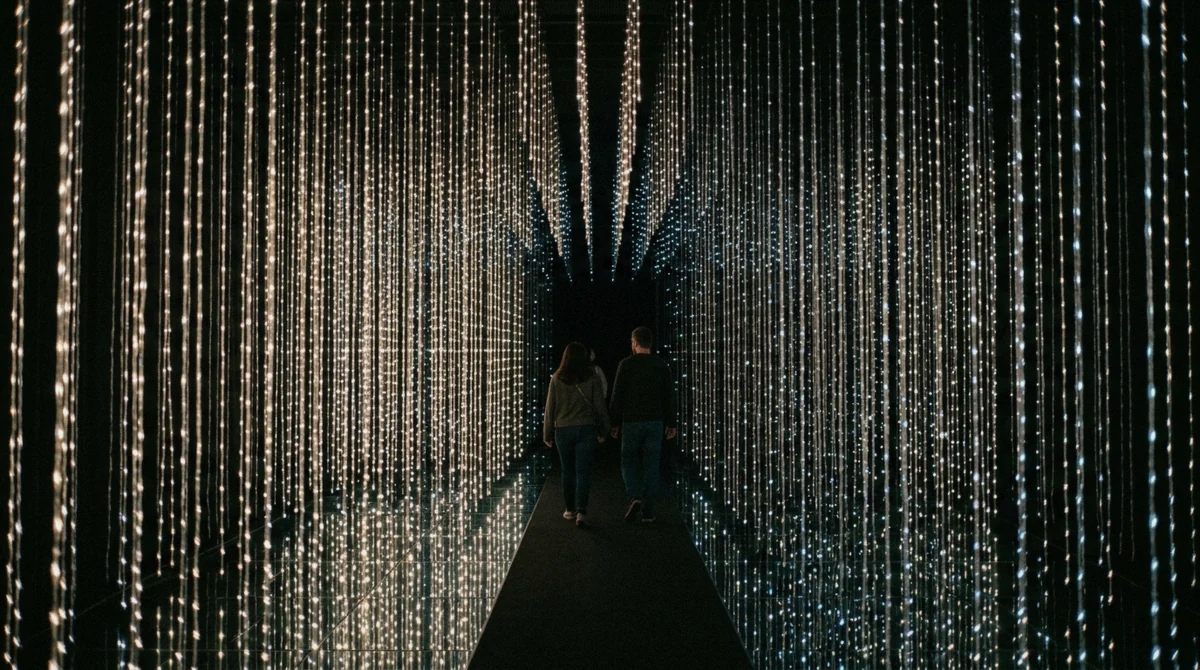
| Infinite Crystal World | Hanging light strands in deep darkness | Hard, needs a steady hand and slow shutter |
| Universe of Water Particles | The projected waterfall breaking around anyone standing in it | Medium, motion blur is part of the shot |
| Future Park with Sketch Ocean | A fish you coloured swimming into the projected sea | Easy, bright and well lit |
| EN TEA HOUSE | A digital flower blooming inside a tea bowl | Medium, close focus in low light |
| Light Sculpture - Flow | On the Asymmetry of the Universe, running to 8 October 2026 | Medium, shifting colour cycles |
Camera and Phone Settings for Near-Darkness
Most of the building is far darker than a phone camera's automatic mode expects, and the fixes are straightforward once you know the room is dark on purpose rather than a lighting fault to correct for.
- Turn off flash entirely before you go in, not just for the rules but because it ruins the shot regardless
- On a phone, avoid portrait mode. It relies on separating a subject from a background using depth data, and a dark room full of moving light confuses that separation, producing blurred edges around people and objects
- Brace the phone or camera against a wall, a railing or your own chest rather than holding it free in the air; with no tripod allowed, a stable brace is the only substitute for one
- On a camera, raise ISO before you drop shutter speed too far. A slightly grainy but sharp frame beats a clean but blurred one in a room this dark
- In Infinite Crystal World specifically, a half-second pause after raising the phone lets the automatic exposure settle before you tap the shutter
- Wipe the lens before entering. Fingerprints and condensation from moving between warm and cool rooms show up badly against dark backgrounds
None of this requires specialist equipment. A recent phone handles Bubble Universe and Future Park easily in automatic mode; Infinite Crystal World is the one room where a dedicated camera with manual exposure control has a real edge over a phone. If you shoot video rather than stills, the same bracing rule applies even more strictly, since handheld footage in a dark room amplifies every small movement into visible shake once you get home and watch it back on a larger screen than the one you shot it on.
| Setting | Phone | Camera | Why |
|---|---|---|---|
| Flash | Off, always | Off, always | Banned in the museum and it flattens the projected light regardless |
| Mode | Standard photo, not portrait | Manual or aperture priority | Portrait mode's depth separation fails in moving light; manual mode holds exposure steady |
| Stability | Brace against a wall or your body | Brace against a wall or your body | No support over 30 cm is allowed, so a tripod is not an option either device |
| Sensitivity | Let auto-ISO rise | Raise ISO before slowing shutter too far | A sharp, slightly grainy frame beats a clean but blurred one in near-darkness |
| Timing | Pause half a second before shooting | Meter, then shoot | Lets automatic exposure settle in the dark before the shutter fires |
What to Wear and Carry
What you wear affects both comfort and how the museum reads your movement through mirrored rooms, so it is worth planning beyond a normal museum outfit.
- Flat, closed shoes rather than heels or sandals, several rooms have uneven or reflective flooring
- Trousers or shorts rather than a loose skirt or dress, unless you plan to use the wrap-around skirts staff lend at the entrance
- A phone or camera with the lens already clean and flash switched off before entering
- A cross-body bag or pockets rather than a shoulder bag that swings, since there is no tripod to free your hands and you will be shooting one-handed often
- A spare battery or power bank if you plan to shoot for the full visit, since there is no time limit once inside and phones drain fast in continuous low-light shooting
- Nothing over 30 centimetres that could be mistaken for a support: leave tripods, monopods and selfie sticks at the hotel rather than at the door
🎯 Our recommendation: book the 8:30 opening slot on a weekday if photography is the actual point of your visit. The difference between the first ten minutes after opening and a mid-afternoon slot is the difference between an empty Bubble Universe and one with fifteen other people's reflections in every frame.
Timing the Visit
Hours run 8:30 to 21:00 with last entry one hour before closing, and there is no time limit once you are inside, so timing your entry matters more than rushing your visit. On busy days, Infinite Crystal World is entered using a numbered ticket pulled through the teamLab app rather than a simple queue, which spreads visitors out but also means the room is rarely empty even at a quiet hour. Weekday mornings outside school holiday periods remain the most reliable window across every room, not just Infinite Crystal World, since weekend attendance runs noticeably higher throughout the building and the difference shows up in every frame that includes other visitors.
- First slot, 8:30 on a weekday: the emptiest window in the building for any room
- Pull your Infinite Crystal World number in the app as soon as you enter rather than waiting until you reach that room
- Do a fast first lap to get oriented, since there is no map and rooms migrate, then double back to whichever room photographed best on the first pass
- Because artworks run on multi-minute cycles, a disappointing frame early in the visit is worth trying again later rather than writing off the room entirely
Getting There and What Admission Costs
teamLab Borderless sits on B1 of Azabudai Hills Garden Plaza B, two minutes on foot from Kamiyacho Station Exit 5, with an underground passage running straight to the entrance. Adult admission runs ¥3,600 to ¥5,600 depending on the date and the entry slot chosen, and the first weekday slot at 8:30 is both the cheapest end of that range on most dates and the emptiest room for photographs, so the two things line up in your favour if you book early.
One room worth planning a shot around: Light Sculpture - Flow reopened on 8 July 2026 with a new work, On the Asymmetry of the Universe, running through 8 October 2026 at no extra ticket cost. It is worth checking on the way in whether it is still showing before you build a shot list around it, since the run does have an end date. A guided visit that already holds a fixed slot, such as this three-hour Borderless walk from $119, is one way to remove the booking guesswork entirely if photography planning is already taking enough of your attention.
Borderless is not the only teamLab museum worth a camera. Our Borderless versus Planets comparison covers the barefoot, water-based sister venue in Toyosu, which photographs very differently and rewards a wide-angle, motion-blur approach instead of the near-darkness technique described above. And if photography is only part of a bigger question about whether the visit earns its place on a Tokyo itinerary at all, our honest look at whether Azabudai Hills is worth it weighs that beyond the camera bag.
Frequently Asked Questions
Can you take photos in teamLab Borderless?
Yes, photography and video are allowed throughout and you may post what you shoot. The only restrictions are no flash and no support over 30 centimetres, which rules out tripods, monopods and selfie sticks.
What do you wear to teamLab Tokyo?
Flat closed shoes and trousers or shorts work best, since several rooms have mirrored or uneven floors. Staff lend wrap-around skirts free at the entrance if you arrive in a dress or skirt.
Are tripods or selfie sticks allowed?
No. The museum bans any photography support longer than 30 centimetres, which covers tripods, monopods and selfie sticks, for both phones and dedicated cameras alike. Bracing the phone or camera against a wall or your own body is the practical substitute.
Which room photographs best?
Bubble Universe and Infinite Crystal World are the two most photographed rooms. Bubble Universe is forgiving and easy to shoot in most light; Infinite Crystal World is darker and rewards a steady brace and a moment's pause before shooting.
How long do you need at teamLab Borderless?
There is no time limit once inside, and most visitors spend two to three hours. Photographers who want a second pass through favourite rooms after the light cycles change should plan closer to three hours.
Is flash photography allowed at teamLab Borderless?
No, flash is banned throughout the museum. It washes out the projected light the rooms depend on, and staff do enforce the rule.
Does the teamLab app help with photography?
Yes, it is used to pull a numbered entry ticket for Infinite Crystal World on busy days, which is worth doing as soon as you enter rather than waiting until you reach that room. It also carries the artwork concepts for every piece, since the museum runs without wall labels, which is useful if you want context for a shot after the fact rather than pausing to read anything mid-visit.