 Azabudai Hills Tokyo
teamLab Borderless Review: Is It Worth It?
Every teamLab Borderless review comes down to the same fork. Book the first slot of a weekday and give it two full hours and the place earns its reputation. Buy a mid-afternoon weekend ticket and treat it as a twenty-minute walk-through between other plans, and you will leave with the overrated verdict that fills half the forum threads about this place. Adult admission runs ¥3,600 to ¥5,600, about $23 to $36, and the gap between a great visit and a disappointing one is almost entirely about which slot you book and how long you stay, not luck. This review covers the real cost, what the money buys, the common complaints answered honestly, and who should skip it. For the ticket mechanics and closure dates in full, see teamLab Borderless tickets and hours, and for the rest of what a visit to the neighborhood costs, see planning a day at Azabudai Hills.
Quick answer
Yes, if you book an early weekday slot and stay close to two hours, since the artworks run on multi-minute cycles and a rushed walk-through misses most of what makes them work. Adult tickets run ¥3,600 to ¥5,600 (about $23 to $36), and the museum sits two minutes from Kamiyacho Station in the basement of Garden Plaza B. The verdict flips for a crowded, rushed visit, which is exactly the version most negative reviews describe. Full ticket details live on our teamLab Borderless page, and a guided tour removes the timing decision entirely by booking the slot for you.
Key takeaways
- Adult tickets run ¥3,600 to ¥5,600, about $23 to $36, set by date and entry time
- Two hours is the real visit length; the ticket fixes entry, not exit
- The best version of the museum is the 8:30 weekday slot, the worst reviews come from crowded weekend afternoons
- There is no map by design, which is either the best or worst part depending on the visitor
- Skip it only if you have already booked teamLab Planets, since the two overlap heavily
- A guided tour from $119.02 bundles the ticket with a fixed, good time slot
Pros and Cons, Honestly
What we genuinely like
- Genuinely different from anything else in Tokyo, rooms that respond to how you move through them
- The 8:30 weekday slot is close to a private viewing
- Photography is allowed without flash, and several rooms have mirrored floors built for it
- EN TEA HOUSE, where a digital flower blooms in your bowl and keeps blooming while tea remains
- No time limit once you are inside, a slow two hours costs the same as a rushed thirty minutes
The honest downsides
- No map and no set route, which some visitors find disorienting rather than freeing
- Weekend afternoons get crowded enough that queueing inside individual rooms is normal
- No re-entry, so once you leave the day is over
- No restaurant beyond EN TEA HOUSE and vending machines, plan food around the visit
- The price rises the closer you book to a popular slot
Who it's NOT for: Visitors who want a fixed, guided narrative with wall labels, or anyone booking a mid-afternoon weekend slot expecting the calm of the marketing photos.
What ¥3,600 to ¥5,600 Actually Buys
The museum sits on B1 of Garden Plaza B, two minutes from Kamiyacho Exit 5, inside a complex that costs nothing to walk once you are through the door. Adult admission is ¥3,600 to ¥5,600, children 4 to 12 pay ¥1,500, and the exact price depends on the date and the entry slot rather than being a single fixed number. Two hours is the realistic visit: the ticket fixes your entry time but not your exit, and there is no limit on how long you stay once inside, so a quiet weekday morning can easily stretch past two hours without anyone moving you along.
| Attraction | Price (adult) | What you get |
|---|---|---|
| teamLab Borderless | ¥3,600 to ¥5,600 | No time limit, rooms on multi-minute light cycles, EN TEA HOUSE |
| Shibuya Sky | ¥2,700 before 15:00, ¥3,400 after | Open-air rooftop deck, timed entry, one pass through |
| Tokyo City View, Roppongi Hills | ¥2,200 online | Indoor deck on floor 52, no time limit |
| Tokyo Skytree Tembo Deck | from ¥1,800 | 350 m deck, combo tickets add the Tembo Galleria |
| teamLab Planets, Toyosu | from ¥3,600 (dynamic) | Barefoot, water and mirror rooms, closes end of 2027 |
At the same money as a Shibuya Sky ticket, Borderless gives you a room-by-room experience with no fixed route and no clock running once you are inside, which is a different kind of value than a single deck with a view. There is no map by design, which is the single most divisive thing about the place: some visitors love wandering into a room they did not expect, others find the lack of signage stressful in a crowd. The teamLab app carries the concept notes the walls do not, and on busy days it is also how Infinite Crystal World issues its numbered entry slots.
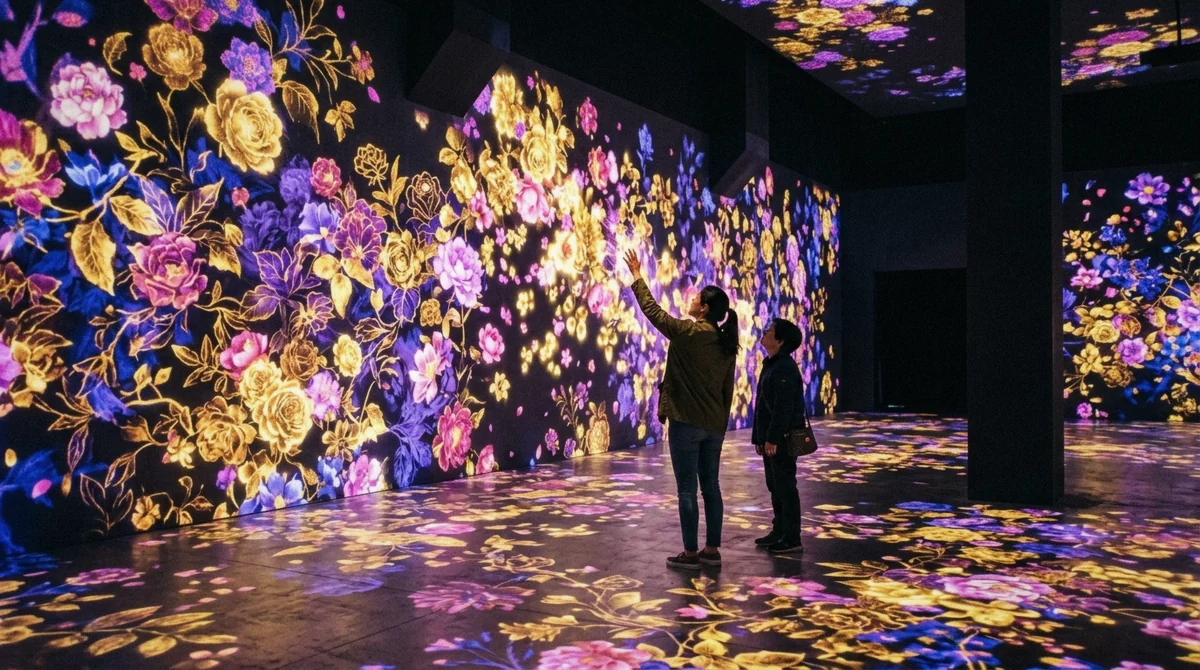
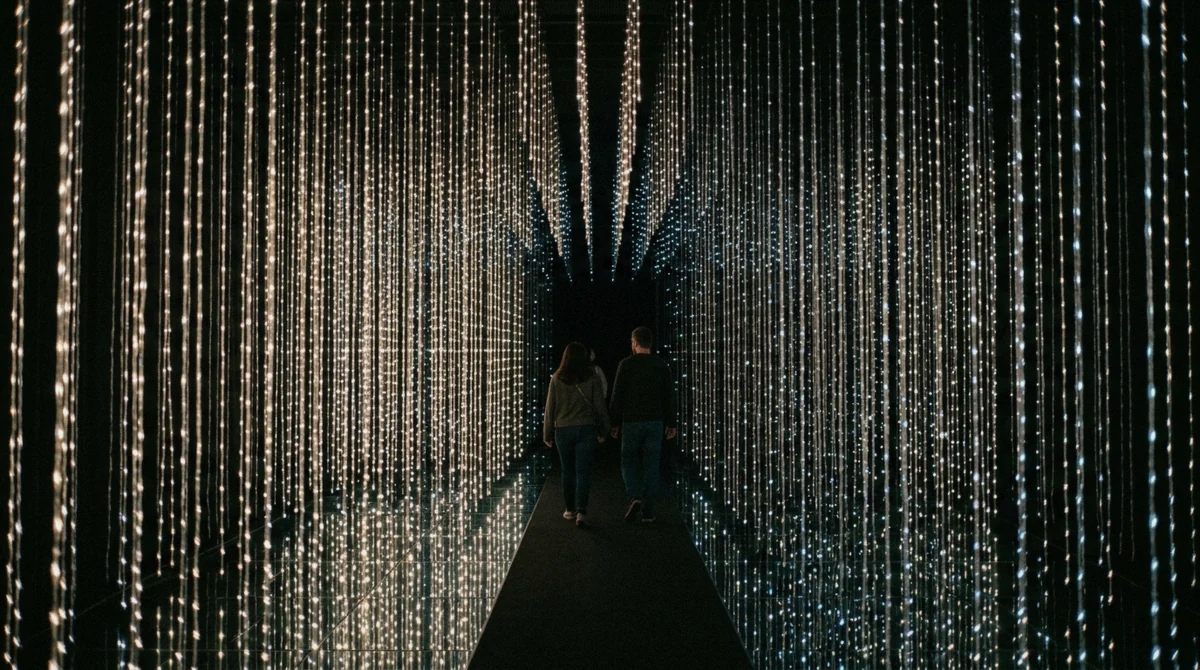
The rooms themselves are what the price is actually paying for. Bubble Universe fills a corridor with mirrored orbs that respond to movement. Infinite Crystal World hangs thousands of programmed light strands in a mirrored room, and it is the one place inside where the app's numbered ticket system genuinely matters on a busy day.
Universe of Water Particles, the waterfall carried over from the original Odaiba museum, runs down a two-story wall and is one of the few works large enough to hold a crowd without feeling crowded. Future Park's Sketch Ocean lets a child color a fish on paper and watch it swim into a projected sea moments later, which is the single most reliable room for keeping young visitors engaged. Light Sculpture - Flow reopened on 8 July 2026 with a new work, "On the Asymmetry of the Universe", running to 8 October 2026 at no extra ticket cost, so a visit through the rest of 2026 catches a piece that will not be there indefinitely.
Photography and video are allowed and can be posted, with no flash and no supports over 30 cm, which rules out tripods, monopods and selfie sticks. Several rooms have mirrored floors, and staff lend wrap-around skirts so you are not worrying about what the mirror shows. Practical limits worth knowing before you buy: no re-entry once you leave, no restaurant inside beyond EN TEA HOUSE and vending machines, and no strollers, since the museum runs a luggage room instead.
None of these are dealbreakers on their own, but stacked together they explain why some reviews describe the visit as more physically demanding than expected, especially for a parent carrying a young child through a two-hour walk.
Booking the Slot That Actually Matters
Tickets go on sale two months ahead and carry a fixed entry time, with the exact price band and category mechanics covered in full on our teamLab Borderless tickets page. What matters for this review is simpler: pick the earliest weekday morning your itinerary allows, and treat everything after that as a formality. If your first choice of date fills, the date can be changed up to three times, at least two hours before the original slot, so booking early and adjusting later costs nothing but a few minutes online.
- Weekday mornings, especially the first slot of the day, are the closest thing to a guaranteed calm visit
- Weekend and holiday afternoons are the slots most likely to produce the crowded, rushed version of the museum
- Rainy days push demand toward whatever slot is left, since Borderless is one of the few full-day indoor options in the area
- Eat before you arrive or budget for EN TEA HOUSE and vending machines only, since there is no full restaurant inside
Two more practical notes worth knowing before you book. There is no re-entry once you leave, so treat the ticket as a one-way pass for the day rather than something to step out and back into. And because strollers are not allowed inside, a luggage room is provided instead, which matters if you are visiting with a young child who will need to be carried rather than wheeled through the busier rooms.
The slot you pick changes the museum more than any other decision you make, so here is what two hours actually looks like at four different entry times, with opening hours of 8:30 to 21:00 and last entry one hour before closing as the frame.
| Entry slot | What the rooms are like | What you trade |
|---|---|---|
| 8:30, weekday | Close to empty for the first hour, easiest photography, full access to every room without a wait | An early start and no lie-in |
| Midday, weekday | A moderate crowd, still walkable, most rooms open without a real queue | Some waiting to enter Infinite Crystal World |
| Weekend afternoon | The busiest hours, queueing inside popular rooms is normal | The least personal space and the hardest conditions for photos |
| Last entry, around 20:00 | The crowd thins as closing nears and the pace slows again | Less time to linger before the 21:00 close |
None of these four visits is the wrong one exactly, but only the first two consistently produce the unhurried, close-to-private experience the museum is designed around, which is the whole argument this review keeps making about timing over technology.
Should You Go? Quick Answers by Situation
If You have three days in Tokyo and one free morning
Book the 8:30 weekday slot if your dates allow it. This is the version of the museum the marketing photographs show.
If You are traveling with a toddler
Go, but skip the stroller, since none are allowed inside, and expect to carry a young child through most rooms.
If Photography is your main reason for visiting
Worth it. No-flash photography is permitted and several rooms have mirrored floors built for exactly this.
If You deal with claustrophobia or sensory sensitivity
Be cautious. Dark rooms, mirrors, and no map can overwhelm on a crowded weekend; a quiet weekday slot is a safer choice.
If You have already booked teamLab Planets in Toyosu
Consider skipping Borderless on the same trip. The two overlap enough that most visitors are satisfied with one; see our Borderless versus Planets comparison before booking both.
If It is a rainy afternoon and you need an indoor plan
Good fit, but book ahead. Rainy-day demand pushes weekend afternoon slots toward the more crowded end of the range.
The Honest Complaints, Answered
Every review site carries the same four objections. Here is what is true in each and what a better slot fixes.
- "It's too crowded." True on weekend afternoons, when queueing inside individual rooms is normal and Infinite Crystal World in particular can mean a real wait for your numbered slot. Untrue at 8:30 on a weekday, when the same rooms are close to empty for the first hour and there is nothing to queue for at all
- "The queue for the ticket itself is long." Rare with an official timed ticket bought in advance, since the slot controls entry rather than a first-come line at the door. The queue people describe in reviews is usually the wait to enter a single popular room, not the front door, and it is worse on exactly the weekend afternoons the crowding complaint already covers
- "It's expensive for what it is." At ¥3,600 to ¥5,600 it sits in the same band as Shibuya Sky or the Skytree Tembo Deck, both single-pass attractions with a fixed route and no seating included. Borderless has no time limit once you are inside, which changes the value math for a slow visitor: the same ticket that feels pricey for a twenty-minute walk-through looks different across a full two hours
- "It's just projections." The rooms run on genuine multi-minute cycles, so a work you glance at for ten seconds and one you stand in front of for three minutes are close to different pieces. A brisk walk-through sees a fraction of what each room does, and that rushed pace, more than the technology itself, is exactly what produces the overrated verdict repeated in the harsher reviews
The thread connecting all four complaints is timing, not the museum itself. The 1.69 million visitors who came through in 2025, and the TIME World's Greatest Places recognition in 2024, describe a museum built around unhurried movement through slow-cycling rooms, not a photo-op you clear in twenty minutes. Book early, stay two hours, and most of the common disappointment simply does not apply to your visit.
The visitors who leave unimpressed are, more often than the reviews admit, describing a rushed thirty-minute pass through a crowded room rather than the museum as it is designed to be seen.
Who This Museum Suits Best
First-time visitors to Tokyo tend to leave the most impressed, largely because they have nothing to compare it to and take it on its own terms rather than measuring it against a memory of the original Odaiba museum, which drew a Guinness-record 2.2 million visitors in its final full year before closing in 2022. Photographers do well here for the same reason the mirrored floors exist: the rooms are built to be photographed, and no-flash shooting is explicitly allowed rather than tolerated.
- Families with children aged roughly four and up, thanks to interactive rooms like Sketch Ocean and the reduced ¥1,500 child ticket
- First-time Tokyo visitors with no fixed comparison point, who tend to rate the experience highest
- Photographers, given the explicit no-flash allowance and multiple mirrored rooms
- Couples and solo travelers with two hours to spend slowly rather than rushing between stops
- Anyone already planning to see teamLab Planets on the same trip should read Borderless versus Planets first, since the overlap is real
Independent visitors can absolutely plan this one alone with an official ticket bought in advance; a guided tour is a convenience, not a requirement, and the museum is designed for exactly this kind of self-paced, no-map wandering. Where a guided tour earns its price is for visitors who would otherwise end up booking whatever slot happens to be left, since the guide books the good slot on your behalf and removes the one variable this whole review keeps returning to. Either way, the decision that matters most happens before you ever walk in the door.
Frequently Asked Questions
Is teamLab Borderless worth the hype?
Yes, for most visitors who book a good slot. The rooms run on multi-minute cycles built for unhurried movement, and the 8:30 weekday slot in particular delivers close to the calm, crowd-free version shown in the marketing photos. A crowded weekend afternoon delivers a noticeably different, more frustrating experience.
How much time should you spend at teamLab Borderless?
Two hours is the realistic visit. The ticket fixes your entry time but not your exit, and there is no limit on how long you stay once inside, so give it the full two hours rather than treating it as a quick stop.
Which is better, teamLab Borderless or Planets?
They are different formats at the same starting price: Borderless is shoes-on and room-based in Azabudai Hills, Planets is barefoot and water-based in Toyosu and drew 2.51 million visitors in 2025. We cover the full comparison in Borderless versus Planets.
Is it worth it with children?
Generally yes. Children 4 to 12 pay ¥1,500, and interactive rooms like the Sketch Ocean, where a child's drawing swims into a projected sea, are built for young visitors. Strollers are not allowed inside, so plan to carry a young child through the busier rooms.
Is it worth booking a guided tour instead?
If you would rather not choose your own slot, yes. A guided tour from $119.02 includes the museum ticket at a fixed, sensible time and offers free cancellation up to 24 hours ahead, which removes the single decision this review keeps coming back to and takes the guesswork out of picking between a good slot and a bad one.
Can I visit without a fixed route or map?
Yes, and that is intentional. There is no map by design, which some visitors find freeing and others find disorienting in a crowd. The teamLab app carries the concept notes for each work since there are no wall labels.
Is teamLab Borderless good for photography?
Yes. Photography and video are allowed without flash and without supports over 30 cm, which rules out tripods and selfie sticks, and several rooms have mirrored floors with wrap-around skirts on loan at the entrance. See our photo spots guide for room-by-room technique.
None of the common complaints about this museum are wrong exactly, they are just describing a badly timed visit. Book the early slot, stay the two hours, and the ¥3,600 to ¥5,600 buys one of the more genuinely different two hours available in Tokyo, closer in spirit to standing in front of a slow-moving work of art than to riding an elevator to a view. If the Sky Lobby view or the market upstairs are also on your list, our reviews of the Azabudai Hills Sky Lobby and the food market cover what else in the complex is worth the walk, and between the three you can build a full day around Garden Plaza B without repeating the same argument twice.